
 Home
Home
 Governance and Performance
 Enabling LGUs
 Representing, Lobbying and Advocacy

Anza | The Spring That Marks the First Step Into the Village

Perched on the shoulders of two hills south of Jenin, the village of Anza appears like a wide balcony, unfolding a layered view from mountains to valleys and all the way to the distant sea. On its terraces, steadfastness takes shape in olive trees rooted beside stone, while nearby, Wadi al-Bishm has returned to greenery as water reclaimed its course. In the fields, the damask roses planted by women leave their mark as a stubborn beauty at the heart of the landscape. From this height, the village both guards its land and opens it to the horizon.
As most of our grandparents’ stories begin around natural springs, the story of Anza begins with its spring standing at the village’s first threshold. It is as if the writer of history placed it there deliberately, to be the village’s open ledger—inscribing people’s paths upon its stones, and carrying in its water the echoes of seasons and voices. Around it, farmers’ footsteps converged, children’s sounds intertwined, and generations passed on its tales until the spring became the first line in the village’s history, and a symbol of Palestine, where every spring is a testimony of endurance.
From this threshold, the scene continued with contemporary steps: the ancient well was restored, the surrounding square re-ordered, and pathways shaped to welcome all. Villagers were part of this process, engaging in voluntary work that made the project a direct extension of themselves—imprinting their daily presence upon the place just as their ancestors had left theirs.
The impact soon became clear: the spring regained its role as a daily gathering point, where visitors encounter their first image of the village and residents meet in an open space for connection and exchange. With this renewed presence came small but tangible gains: new jobs, additional revenue for the village council, and cultural and social activities that re-rooted heritage in the awareness of younger generations.
Today, Anza defines itself through both its heights and its spring: a balcony that opens to the horizon, and a threshold that preserves memory. Between the fields flowering on the hillsides and the spring that guards the entrance, the story of a living Palestinian village is written—adding a new line to a history that stretches beyond its boundaries.

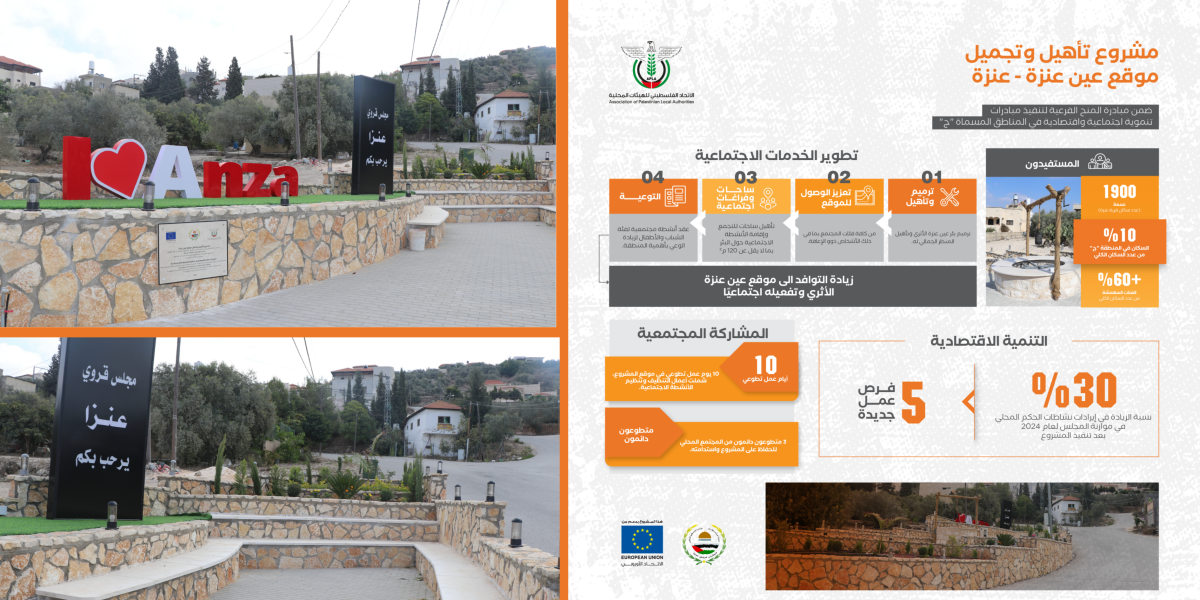
These projects are part of the Sub-Grant Program, which is implemented by the Association of Palestinian Local Authorities (APLA) in Area C. The initiatives under this program are not merely about infrastructure improvement, but serve as practical tools to keep communities rooted in their land, expand spaces of life in the face of closure and confiscation, and turn development into a daily act of resilience that safeguards rights, memory, and existence.
funded by: the European Union and the Swiss Agency for Development and Cooperation (SDC)