
 Home
Home
 Governance and Performance
 Enabling LGUs
 Representing, Lobbying and Advocacy

Wadi Hamad Rehabilitation and Reconstruction project, “The Land is Ours.” | Kafr Ni’ma Village Council

Wadi Hammad, Kafr Ni’ma: Safeguarding Land, Preserving Memory
Kafr Ni’ma, a name that has spoken of abundance for centuries. Kafr means “home” or “place,” and Ni’ma means “blessing” or “fertility.” Together, the name becomes “the home of blessings”—the home of a land that gives as much as it is cared for. The name was no coincidence, but the echo of a deep-rooted bond between people and their place, a bond built on care, endurance, and the will to remain.
To the west of Ramallah, Kafr Ni’ma stretches with modern homes that continue to grow, yet its heart remains unchanged: broad land encircled by ancient traces of past civilizations, and a collective memory inseparable from the soil. Within this landscape runs Wadi Hammad—a natural space that for decades offered the community a breath of air, where winter waters mingled with children’s footsteps, and the shade of trees welcomed farmers returning from their fields.
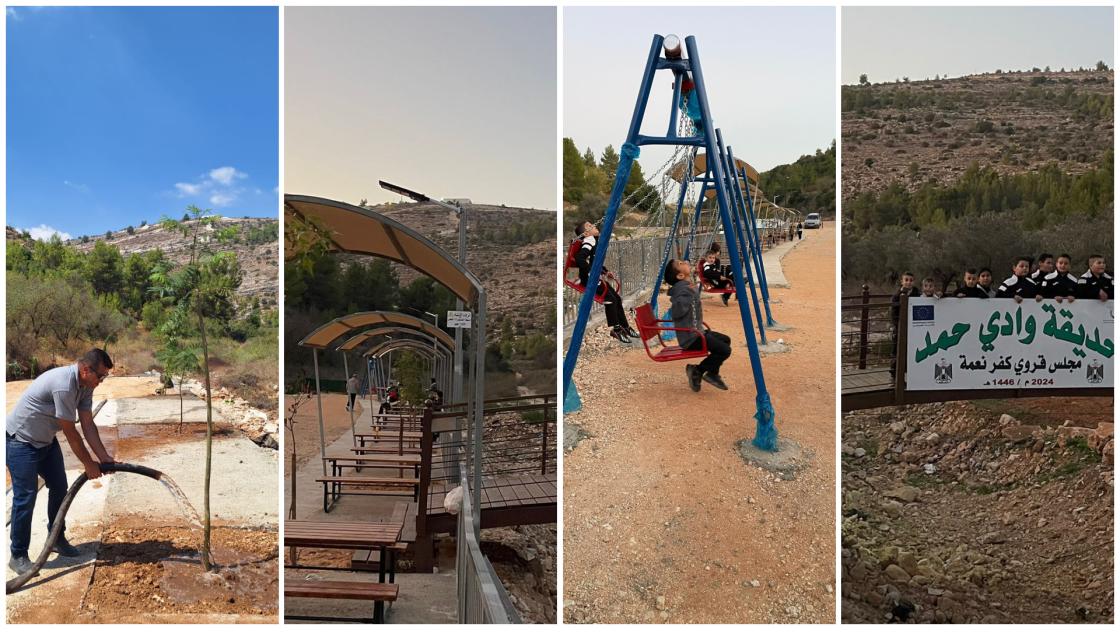
From this valley came the “Rehabilitation and Revitalization of Wadi Hammad – The Land is Ours” Project, a step that returned the wadi to its role as a living communal space. A bridge was built to link its banks, pathways were laid to ease movement, and more than 400 square meters of green public space were prepared for families and gatherings. The wadi was transformed into an open ecological park, where people meet as they once did—now in an environment designed for comfort and shared use.
The impact was swift and visible: visitor numbers rose by 20%, young people found new jobs, and the growth in eco-tourism encouraged small projects serving the site and its visitors. The village council’s budget increased by 15%, proving that nature, when preserved, can become both an economic and social resource.
The project was a true collective effort, shaped by the hands of the community. Over 120 days of volunteer work left their mark on the valley—trees were planted, trails arranged, and the space reshaped into a public common worthy of its people. From this commitment, a team of ten permanent volunteers emerged to support the council in managing and sustaining the site, ensuring it remains part of daily life.
Yet Wadi Hammad’s importance lies not only in its environmental and cultural value, but also in its vulnerability. The site faces repeated settler incursions and threats of takeover, making its protection a form of resilience. The project became more than development—it became a stand for the land, a safeguard for memory, and a clear message that the valley belongs to its people.
Today, Wadi Hammad reflects the very meaning of Kafr Ni’ma—the home of blessings: a place that gives as long as it is preserved, a renewed bond between land and community, where heritage is lived daily, deepening belonging and affirming steadfastness.