
 Home Page
 Capacity Building
 Community Engagement
 Media
Media
 Studies, Guidelines

Community Participation Program | Building Awareness for Sustainable Local Development

APLA launched the Community Participation Program under the project “Empowering Palestinian Community to Utilize Sustainable Development Opportunities”, supported by the Belgian Agency for International Development (Enabel).
The program reflects APLA’s ongoing commitment to strengthening participatory approaches in local development and empowering municipalities to engage citizens in protecting their environment and advancing community well-being.
The initiative embodies APLA’s vision of local governments as open, inclusive spaces that connect citizens with decision-making and transform participation into a pathway for rebuilding trust and promoting collective awareness of environmental justice and sustainable development.
A Broad Participatory Framework Linking Policy to Practice
Developed through an inclusive process led by APLA and its SDG Taskforce, the program began with a framework of 70 community-based activities, later expanded to more than 200 initiatives generated during a collaborative brainstorming session with representatives of LGUs.
The design process was guided by consultations with the municipalities of Hebron, Dura, Bethlehem, Beit Jala, Nablus, Al-Eizariya, Tulkarem, Anabta, Jericho, Tubas, Ramallah, Al-Bireh, and Beitunia, aiming to identify key environmental priorities and turn them into practical, local interventions.
The Municipality of Dura became the pilot model, leading the first implementation phase through two main activities:
- Designing a cultural and environmental trail that reflects the city’s historical and natural identity.
- Organizing tree-planting campaigns led by the Youth Council after receiving training on environmental and climate issues aligned with the 2030 Agenda.
Knowledge and Tools to Support Local Action
To help municipalities implement their activities effectively, APLA provided technical, logistical, and knowledge-based support — including educational materials and interactive tools on the Sustainable Development Goals (SDGs). Municipalities also received trees, benches, and educational signboards to ensure the activities’ sustainability and create visible, lasting impacts on the ground.


From Awareness to Action: Local Experiences in Palestinian Cities
Youth Training in Dura: Environment and SDGs

As part of its central role in supporting and linking youth initiatives to national sustainable development policies, the Association of Palestinian of Local Authorities (APLA), in partnership with Dura Municipality and Dura Youth Council, delivered an intensive training program titled Sustainable Development Goals and Contemporary Environmental Issues. With the participation of 63 young men and women, the three-day training took place at the Dura International Stadium.
Over the course of two days, trainer Uday Qabajah delivered sessions on the global concepts of sustainable development as outlined in the 2030 Agenda. Qabajah outlined the difference between broad goals, specific targets, and indicators used to measure progress. The training also reviewed Palestine’s national experience in this field and addressed key issues directly affecting the Palestinian context, such as climate change and climate justice. Emphasis was placed on Goal 7 (ensure access to affordable, reliable, sustainable, and modern energy for all) and Goal 13 (climate action). These serve as two foundational pillars in empowering local government units (LGUs) and communities to protect the environment and enhance their resilience to climate challenges.
The training incorporated a comprehensive practical component with interactive activities and educational games designed to solidify the introduced concepts and transform them into a living experience. Young participants engaged in group challenges, memory games, and goal-linking exercises, offering them the opportunity to practice teamwork, critical thinking, and innovation.
To highlight the role of youth as active partners in environmental protection and sustainable development, the training concluded with a field tree-planting activity at the Bir al-Wad promenade. The trainees, alongside local community volunteers, planted over 150 diverse saplings along the walkway. This initiative reflected a shift from awareness to action and affirmed the potential of youth-led initiatives to create direct impact by enhancing green spaces and improving the environmental landscape within Palestinian communities.
As part of APLA’s efforts to implement the SDG Localization Plan, this intervention is also a component of the Community Engagement Program, which APLA put in place to strengthen citizen involvement in development efforts and bridge the gap with LGUs on decision-making issues. These activities were carried out under the Empowering Palestinian Society to Grab Sustainable Development Opportunities project with support from the Belgian Development Agency (Enabel).
Children for Sustainable Development

As part of its ongoing efforts to promote community engagement and raise awareness on environmental issues, the Association of Palestinian Local Authorities (APLA), in collaboration with the Asira al-Shamaliya Municipality, organized an awareness activity with the participation of 130 children. The event aimed at introducing young participants to Sustainable Development Goals (SDGs), enhancing their understanding of the importance of environmental protection, and instilling the values of responsibility and community participation.
The activity used an interactive approach that linked education to fun and practical experience. Children learned about SDGs through innovative activities that helped them understand how these goals relate to their daily lives and how they can contribute through simple behaviors and collective responsibility. To realize these concepts, accompanied by the municipal team, children planted more than 25 seedlings in the school’s garden beds, transforming knowledge into practical action that fosters initiative and connects learning to everyday action.
The Prophet Noah Cultural and Environmental Trail – Dura

The Association of Palestinian Local Authorities (APLA) continues to advance a new approach to local development that positions cultural and environmental identity as a driver for change. Along this vein, APLA contributed to the development of the Prophet Noah Cultural and Environmental Trail in the city of Dura, in cooperation with the Dura Municipality and Ministry of Tourism and Antiquities (MoTA). The trail was inaugurated through a community awareness walking event that embodied the concept of identity- and participation-based development. This initiative was part of the Community Participation Program, implemented in the context of the Empowering the Palestinian Community to Harness Su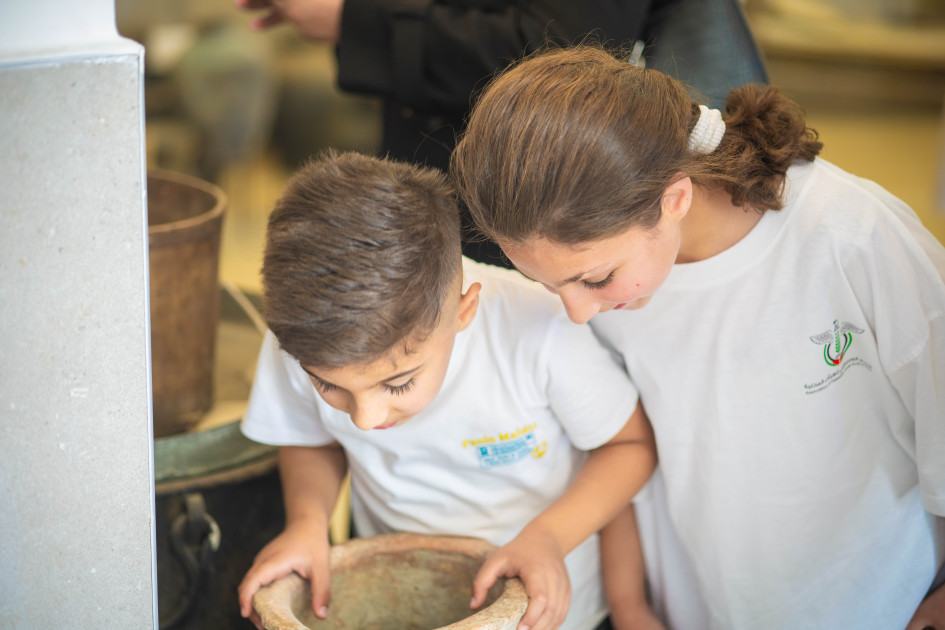 stainable Development Opportunities project, funded by the Belgian Agency International Development (Enabel).
The trail serves as a practical model for how cultural heritage can be used to support local development by integrating historical and environmental dimensions into municipal functions. It transforms public spaces and heritage sites into living interaction points that reshape the relationship between people and place. APLA implemented this concept on the ground through technical supervision, ensuring that the trail was aligned with municipalities’ development vision which is translated into tangible tools. In addition to designing and marking the trail on the ground, this activity included developing a smart interpretive system equipped with QR codes integrated into the informational signage supplied by APLA in coordination with the municipality and MoTA. This approach turns the tourism experience into an act of both learning and development.
This intervention embodies APLA’s philosophy of empowering municipalities to shift from their service-oriented role to a developmental one that leads change within communities. It does so through initiatives that redefine development from a holistic perspective that combines culture, environment, local economy, and community engagement. It also reflects APLA’s vision of transforming municipalities into key engines of development and sources of renewed connection between citizens and their local settings.
This effort aligns with Target 11.4 of the Sustainable Development Goals, which calls for protecting and safeguarding the world’s cultural and natural heritage. APLA works to translate this target into tangible local practice by supporting local government units in integrating the heritage dimension into their policies and development plans with a view to reinforcing people’s connection to their place and enhancing the sustainability of their resources.
Educational Activity in Beit Furik: Students and the SDGs

As part of the ongoing awareness efforts led by the Association of Palestinian Local Authorities (APLA) within the Community Participation Program, the Beit Furik Secondary School for Boys organized an educational activity on Sustainable Development Goals (SDGs). The activity was carried out in cooperation with the Beit Furik Municipality and with technical support from APLA. More than 75 students took part in this exercise, which aimed at enhancing their understanding of development issues, connecting them to their local reality, and highlighting the role of municipalities in achieving SDGs at the community level.
This cooperation reflects the continuity of APLA’s efforts to instill a culture of sustainable development at both community and educational levels. It seeks to consolidate partnership between municipalities and educational institutions in adopting the principles of participation, citizenship, and collective local action. It also demonstrates a growing shift in community awareness, as local institutions have become more engaged with APLA’s approach of integrating developmental awareness into daily practice. Consequently, the link between education and municipal work is strengthened, contributing to more inclusive and sustainable development.
The activity in Beit Furik turned into an interactive learning experience that made students familiar with the concepts of sustainable development in an engaging and accessible way. To this end, activities and games were employed, connecting knowledge to practice and encouraging collective thinking and shared responsibility. Through the SDGs Exhibition prepared by the students in English, participants expressed their understanding of SDGs in innovative ways that reflected their growing awareness of their role in local development.
#YourVoiceMatters – A National Digital Campaign for Environmental Dialogue
As part of its effort to strengthen participatory communication between municipalities and citizens, APLA launched the nationwide digital campaign #YourVoiceMatters (#بدنا_رأيك) in collaboration with municipalities engaged in the Empowering the Palestinian Community for Sustainable Development project, supported by Enabel.
The campaign introduced a new model of municipal–citizen interaction, inviting people to share their ideas on how to make their cities cleaner, greener, and more sustainable. Through 24 interactive posts shared by municipalities, citizens engaged in open discussions on issues such as waste sorting, expanding green spaces, and solar energy use in public facilities.
Rather than one-way announcements, municipal social media pages became spaces for dialogue and collaboration — where citizens could exchange ideas, propose solutions, and take part in reimagining the future of their cities.
In Tulkarem and Jericho, engagement reached impressive levels, with residents offering practical proposals such as rehabilitating public parks, encouraging neighborhood gardening, and linking new building permits to the creation of green areas — illustrating a deep sense of environmental awareness and civic responsibility.
Through #YourVoiceMatters, APLA has set a new benchmark for municipal communication — turning information sharing into participatory governance. The campaign marks a meaningful step toward building environmental citizenship and restoring trust between citizens and their local institutions through listening, dialogue, and shared action.